Lessons from Ummeed: seeing the whole child across clinic and training data
Ummeed was able to connect their clinic and training systems. Clinicians, managers and fundraisers now act on each child's full journey, refreshed every week.
Key Highlights
Ummeed Child Development Center in Mumbai, India, works with children with and at risk of developmental disabilities, and their families. They have served about 15,500 children through more than 152,000 clinical sessions, and trained more than 11,200 professionals. Their data sits in the CMS and TMS, with dashboards on Superset.
Through Dasra's Data Catalyst Program, run with Dalgo, Ummeed was asked to pick one data problem to solve. Their team first traced children's journeys by hand, matching Excel records by phone number. It worked, and it showed the job needed a system.
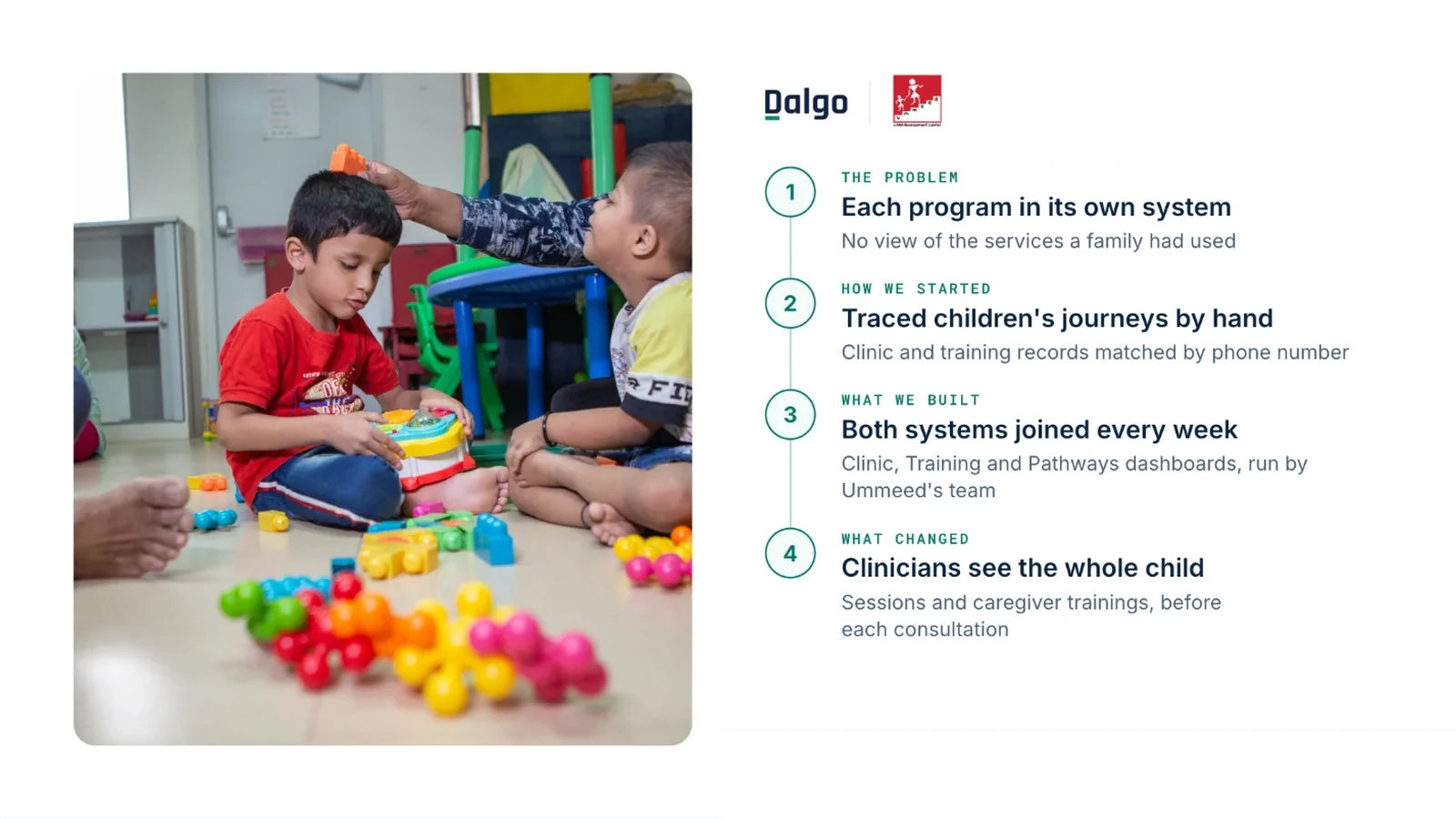
- Both systems connected. Data from the Clinic Management System (CMS) and the Training Management System (TMS) was set to arrive every week through their APIs, cleaned and connected automatically.
- Three dashboards. The Dalgo team built Clinic, Training and Pathways dashboards; Pathways follows each child across both systems.
- A team that runs it. A 4-day handover training on Superset (the dashboard tool), access roles, data quality checks and the dbt models (the code that cleans and connects the data), so Ummeed's team could run it themselves.
| Result | What changed |
|---|---|
| Monthly → weekly | Data refresh, with no manual cleaning in between |
| 2 systems, 1 view | Clinic (15,500+ records) and training (14,000+) connected into each child's journey |
| 4 teams | Monitoring and evaluation (M&E), program, senior management and fundraising teams work from the same dashboards |
| 10 hrs → 1 hr a week | Weekly data cleaning time |
The challenge
A child could first come to Ummeed's clinic at the age of 2 or 3 and return at 7 or 8, while their caregivers were trained and the family used the Family Resource Center, where families support other families. The clinic and training programs each had a separate system, and other programs tracked their data in Excel.
- Monthly manual exports. Cleaning the Excel export from their management information system (MIS) took the M&E team a couple of days, so analysis ran once a month.
- Reports nobody could explore. Power BI ran on static Excel with no licence, so reports went out as non-interactive PDFs.
In a 2022 Family Outcome Survey, many families scored low, 2.9 out of 7, on awareness of their rights and on advocating for their children. Acting on that needed a view of which services each family had used, and no system could show it.
“What didn't work for us is that it was all in silos — it was all for the program. Every time we deployed something, we thought, okay, this is the clinic, so what does the clinic need … But to then think about the entire system for that child — that thought process was not there initially.”
The transformation
Clinic and training data now sit in one warehouse, connected by the child’s record, and four teams work from the same dashboards.
Clinicians and care team. Before a consultation, they now see a child's sessions, caregiver trainings and other services the family has used, so they give more informed guidance and connect the family to the services that fit the child.
Program managers. They read clinic and training numbers together. When clinical sessions dip in a month the same clinicians ran more trainings, managers can see the dip is explained and needs no fix. Before, clinic data alone left them asking why things were not going well.
M&E. The monthly Excel dump cleaning that used to take a couple of days now runs on its own every week. The team uses the dashboards to track progress, spot mission drift and update management and donors, and answers other teams' new questions.
Fundraising. When writing a case story for a donor report, the team reads the child's journey and goes back to the program team with sharper questions, then pulls ready charts filtered to the reporting period. Dashboards for donors themselves are not built yet.
“It helps our care team provide better services for the children and the caregivers; they're able to have more meaningful conversations, because they're aware of the services the family has taken.”
What’s next
Teams now ask M&E for more, which Vinodhini calls a cyclic loop. Next, Ummeed will model how families move through their services, link the journey to child development outcomes, and bring in their other programs. Her advice to other NGOs: do your homework on what you want before you start.