Bhumi: One source of truth for every child Bhumi reaches
Bhumi worked with the Dalgo team to bring their program data into one place, starting with their fellowship assessments. Their own three-person tech team now builds the dashboards and pipelines.
Key Highlights
Bhumi runs education programs in India from grade 2 through graduation. In 2025–26, their programs reached more than 250 schools and nearly 110,000 children and youth, and engaged nearly 130,000 volunteers. They have worked with the Dalgo team since July 2025, on the platform plus consulting: data mapping, a redesigned schema, the first dashboard and a three-day bootcamp.
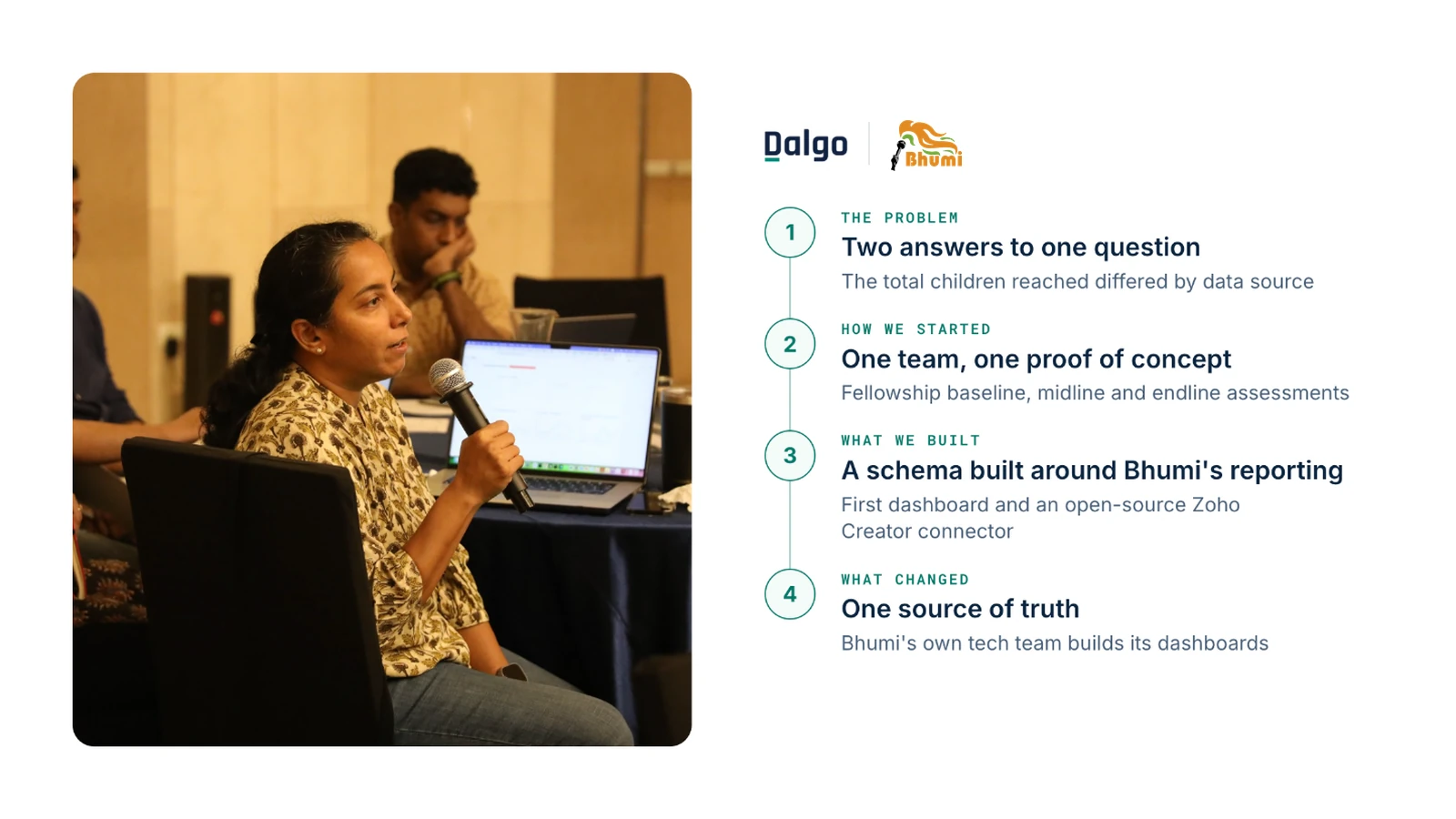
- Started with one team. The Dalgo team mapped Bhumi's data, then ran a proof of concept on the fellowship team's baseline, midline and endline assessments in foundational literacy and numeracy.
- Built around Bhumi's reporting. The Dalgo team and Bhumi’s tech team redesigned the schema around what Bhumi reports, built the first dashboard as a template, and wrote an open-source connector for Zoho Creator.
- Skills that stay. A two-day bootcamp in September 2025 taught Bhumi's tech team dbt (a tool for cleaning and modelling data in code). Field teams kept their day-to-day work unchanged while the system was built.
“But for the time being, we are not disrupting our teams in their day-to-day work, which was a very important consideration for us.”
| Result | What changed |
|---|---|
| One count for every number | Teams now shape their reporting so their data lands in one source of truth |
| Bhumi builds their own | Their three-person tech team writes the pipelines, transformations and dashboards |
| An open-source connector | Built for Zoho Creator, now available to every nonprofit |
The challenge
- Two answers to one question. The total number of children reached could differ depending on which source you looked at.
- Numbers nobody fully trusted. Every analysis meant reworking: getting teams to agree on where the data was and whether it was correct. The data could not show in real time where a program was going wrong or what needed to change.
- Days of preparation. A monthly or quarterly leadership review took two to three days to prepare, sometimes more.
“Which means that if we just asked, what is the total number of children that we reached in a year, we could come up with two different answers depending on which source of data you're looking at. And that's a very fundamental problem to have.”
The transformation
Bhumi now has one source of truth. A team's data counts only if it is there, so teams shape their reporting to fit it, and that is changing how they treat data.
Fellowship team. Baseline, midline and endline results now sit in one dashboard that updates as fellows enter assessments. Program managers drill down to the schools or cities that are lagging and follow up or take corrective action.
Tech team. Bhumi's three-person team builds their own dashboards, pipelines and transformations, and works with the Dalgo team to keep momentum.
Field teams. They are more aware of what data to collect, how to collect it and why it needs to be well structured, and they reach out to the tech team for help with those decisions. Fewer entries need rechecking by hand as teams add their own sanity checks.
“It's easier to get the organisation on board to ensure that the data is flowing into this single source of truth, which is also leading to a stronger culture of being data aware — of having that lens where you're looking at your data and thinking, 'I need to make this clean, I need to make this consistent, I need to do these things so that my data will eventually work for me.' I think that culture is also getting built in the organisation.”
What’s next
Bhumi will move more of their teams' reporting onto Dalgo and expects to see the change in review preparation over the next two to three months.