Lessons from 1000 Days Fund: getting at-risk mothers and children back to the field in time
1000 Days Fund brought five data sources into one warehouse with Dalgo’s consultants, enabling their team to identify at-risk pregnant women and children as cases are flagged in the system and make timely intervention decisions, rather than waiting weeks for reports to reach field teams.
Key Highlights
1000 Days Fund works on maternal and child nutrition in Indonesia through community health workers (kaders), and has reached more than 1 million pregnant women and children under five since 2019. They had six months of platform plus consulting with the Dalgo team, up to September 2026. Their data comes from Kobo, Google Forms and Google Sheets, modelled in dbt and shown in Superset (the dashboard tool).
1000 Days Fund chose Dalgo partly because, in the team’s words, it “comes with a consulting team rather than only a licence key.” Pandu Gusti Resworo, Data Specialist at 1000 Days Fund, led the build, designing the data models in dbt (code that cleans and connects the data) with Dalgo’s consultants, and the organisation has not needed to hire a data engineer. Field teams kept their forms, and everything, including older form versions back to 2019, now flows into one warehouse automatically.
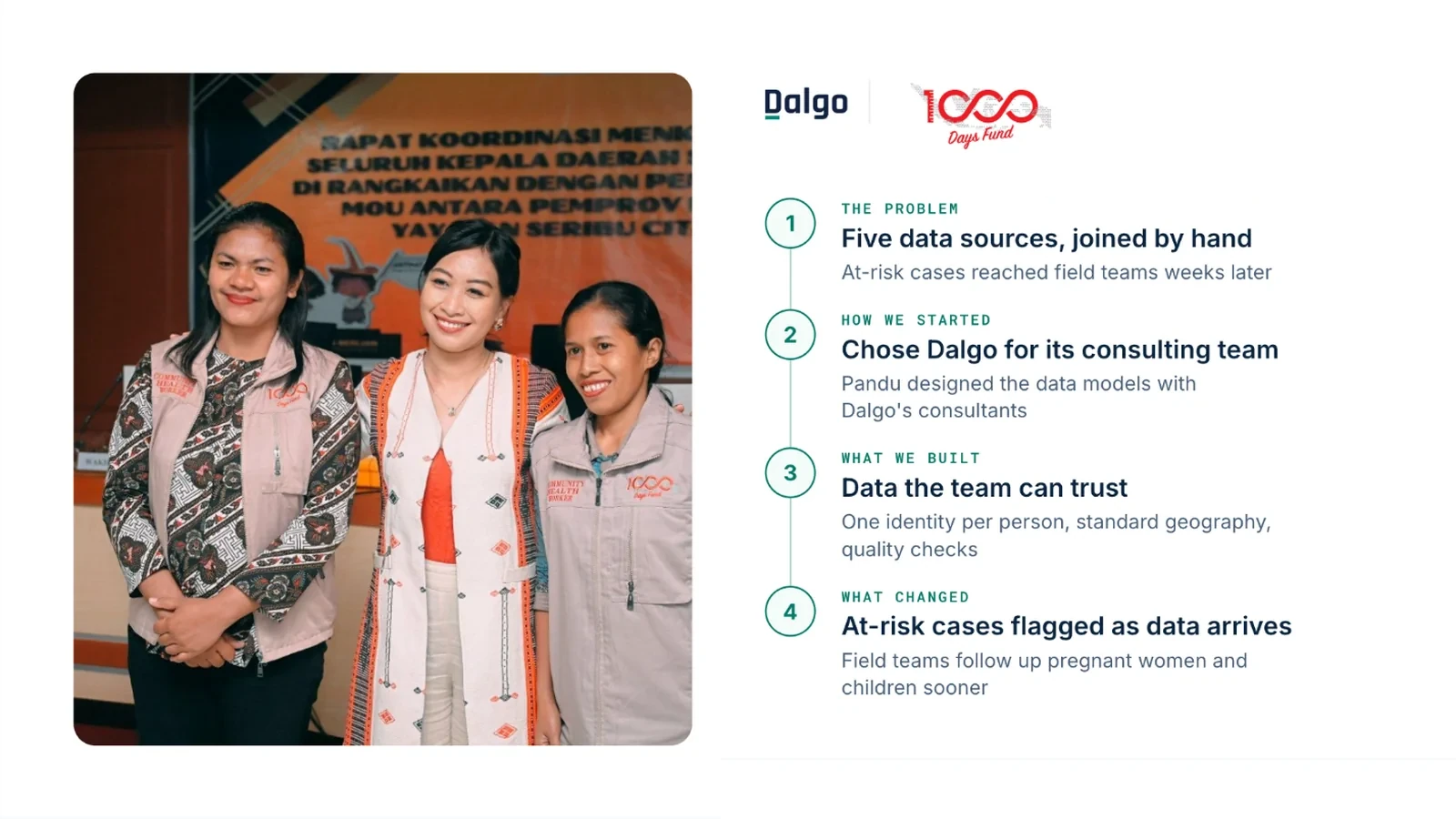
- One identity per person. A six-tier matching cascade uses name, place and the context of each submission, so one kader no longer counts as three people.
- Standard geography. Reference tables resolve spelling variants, so results join across forms.
- Quality checks in the pipeline. Nothing is dropped; implausible values are flagged and sent back to the person who entered them.
- Dashboards in Superset. A systems change assessment view and a leadership overview of reach and outcomes.
| Result | What changed |
|---|---|
| At-risk cases flagged in the system | Field teams follow up pregnant women and children sooner, where cases once reached them weeks later |
| 5 sources → 1 warehouse | Training, Kader Academy, village health post (posyandu) registers and monitoring, and the Community Health Worker Assessment and Improvement Matrix, refreshed automatically |
| 14 training modules | Each person’s pre- and post-test now matched, where only regional averages were possible |
| 2–3 weeks → about 1 week | Monthly data preparation time |
The challenge
1000 Days Fund works through government systems: posyandu (monthly village health posts), puskesmas (public health centres) and village governments. Their Community Care Model trains and supports community health workers, who run home visits, nutrition counselling, growth monitoring and risk screening. The team relied on data to see who was at risk, where the gaps were and whether interventions were working, and to send what they learned back to the kaders who collected it so they could adjust.
That data lived in five sources on personal drives. The dashboard was a Google Sheet pulling from a chain of other sheets, until the tables grew too big to import and a hand-run Python script took over. The team spent more effort keeping this system running than using the data.
- Fragmentation. No single place to ask a question; anything off the dashboard became a project.
- Inconsistency. Free-text names and places on Google Forms. One district, Sumba Barat, was written three ways. Multiply that across every district and village in Indonesia's 38 provinces.
- Manual effort. Two to three weeks a month preparing data, and figures occasionally restated after submission.
“If the answer is not on our dashboard, that could be a whole project and not a simple query.”
The transformation
Every source now flows into one warehouse as tables ready to analyse, so a question that once became a project can be answered from one place, and each team makes informed decisions based on their objective.
Field teams and kaders. At-risk cases once reached them in reports, sometimes weeks later. Now cases are flagged as data arrives, and teams decide which pregnant women and children to visit first from case lists and flags on chronic malnutrition, hypertension, stunting and weight faltering.
Monitoring, evaluation and research (MER) team. Monthly data preparation fell from 2 to 3 weeks to about one week, and the team spends the time saved analysing questions they had no time to explore before. The team works in SQL and dbt in one warehouse, and data errors are flagged in the pipeline and sent back to the kader who entered them.
Program teams. Training results used to be an average score per region. Now they see each person's scores before and after, and who took only one test, and spend their time deciding next steps from one source of data.
Leadership. Leaders see system change and program outcomes in one consolidated dashboard, and argue decisions from one set of indicator definitions across programs and funders.
“I think the most important change is not a shinier dashboard, but the questions that we were able to ask.”
What’s next
1000 Days Fund will add range and plausibility checks, duplicate flags and missed-visit flags, each routed back to the person who entered the data, and automated alerts that send at-risk cases to field teams, village task forces and puskesmas. In the words of Adlina Basuki, Monitoring, Evaluation and Research Manager at 1000 Days Fund, the goal is “to be able to catch the bad values before it becomes a bad decision.”